I landed at The Grocery Store in the fall of 2020 after finding myself unemployed. Raised in a small town in Idaho, I had attended college in Utah, where I studied English. Later, I moved to New York City to attend graduate school at the City University.
Read more ‘Toward a New Beginning’: Lessons and Parallels From the GOP Rout of 1946
After I graduated in 2009, I spent time looking for an academic job: On or off the tenure track, I wanted to teach writing and literature. In the meantime, I lectured a few college courses and sometimes worked as an office temp at a Wall Street firm, a law office, and at a foundation. After two years of rejections from colleges and universities, I had to face the reality that I was one of many people educated in the humanities with virtually no chance of a future in their field. To boot, I was in debt to the tune of tens of thousands of dollars for my tuition.
In 2015, I cofounded an organization called the Debt Collective. My colleagues and I lobbied the federal government to cancel the student loans of borrowers who had attended scam for-profit colleges, eventually winning billions in loan relief. Philanthropic support for the Debt Collective allowed me to earn a decent salary for a couple of years. But eventually funds for organizer salaries became harder to come by, too. Almost 20 years after arriving in New York, I was out of work. In the spring of 2020, I moved back to Utah to make a new start in middle age.
I moved into a downtown neighborhood in Salt Lake City that some called “transitional.” A few years earlier, it had been the site of a homeless shelter and a methamphetamine market. But the shelter had recently been torn down to make room for new, mostly market-price apartments. The area was now composed of a mix of residents, some who lived in the run-down, low-rent buildings that had been there for decades, and a few middle-class people who occupied the newer apartments. I paid $1,350 per month for a studio in one of the new buildings. While the weekly farmers market in the park below my apartment was a sign of gentrification, at night, the drug market continued. A couple of blocks away, people were sleeping in tents on the street. The good news was that I could walk to The Grocery Store (TGS) to shop, a necessity since I could not afford a car.
Then the pandemic hit, and the world stopped. I applied for white-collar jobs in schools and in city government but received few responses, rarely even a “thanks but no thanks.” I felt luckier than others. Members of my family were reeling. My sister-in-law, a bookkeeper, was laid off with no promise of getting her position back. (Indeed, she was not rehired when the pandemic subsided and spent almost a year in unemployment limbo.) My brother, a bartender, also lost his income when his workplace closed. For a reason that had to do with missed paperwork, which I still don’t understand, he was unable to get unemployment benefits. The virus was frightening, but I was even more unnerved by the uneven effects of the policy response. While professionals worked from home, those in basically any industry that couldn’t be done via Zoom were laid off. Stimulus checks, unemployment, and other benefits did not alleviate the anxiety of not knowing when or if anyone would get their jobs and lives back. Then there was the third group: warehouse employees, healthcare workers, and grocery staffers still on the job, worried about getting sick.
Doing my grocery shopping at TGS was a pleasant experience that brought me a semblance of normalcy, as if the store existed in another world. I was grateful (and felt a little guilty) that employees were coming to work every day to ensure that the rest of us could buy food.
One day, I lingered at the cheese counter reviewing the options. An employee approached me wearing a name tag that listed her time on the job: “Two Years of Serving You.” She asked how she could help. I said that I was craving a grilled cheese sandwich. The employee’s eyes lit up. “You want the good stuff.” She offered a local cheddar that had been soaked, she explained, in beer. “That’s why it’s got that deep, rich color and unique flavor.” She promised that the cheese made “the best grilled cheese you’ll ever have” and recommended a store-made brioche. I bought both products.
The encounter impressed me. The employee had treated me like an individual whose cravings mattered. She had even appeared to take pleasure in serving me, a rarity during times like those. I started to think about applying for a job at the store. I was going crazy from being isolated at home. Working at a supermarket seemed like a way to serve my community during the pandemic. At TGS, I could earn money while treating people like the cheese counter employee had treated me.
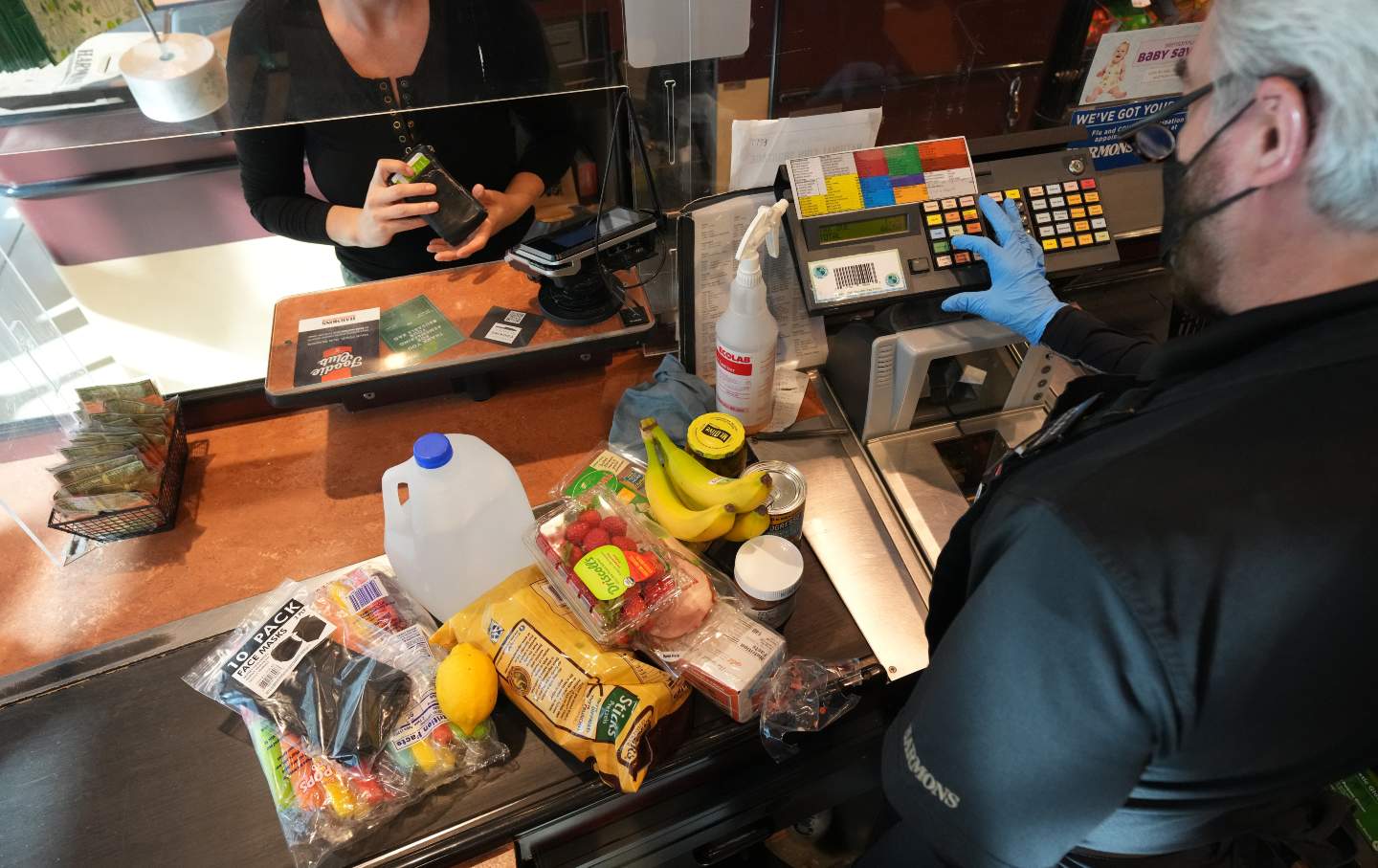
So in October 2020, I uploaded my résumé to the store’s website. A couple of weeks later, I was hired as a cashier and supervisor in a department called the Front End. The day after the interview, I arrived at the store at 7 am for my first shift, becoming one of almost 4 million people who work as retail salespeople, one of the most common jobs in the country.
George, my colleague there, was at perpetual war with late-night shoppers. Each night, an hour before closing, George, wearing a shirt emblazoned with the word “SECURITY,” started pacing in front of the checkout area. Thirty minutes later, he made an announcement on the public address system: “This store is closing in 30 minutes,” he said. “Please bring your purchases to a cashier.”
Another announcement came 15 minutes later, followed by the last at 9:55 pm: “This store will be closing in exactly five minutes.” Between announcements, George walked the aisles, urging shoppers toward the exit. “Time to go,” he’d insist. Since he had the build of a linebacker and an expression that said he wouldn’t take no for an answer, most shoppers complied.
One night, though, a customer did not follow his instructions. “I just have to pick up a couple more things,” the man explained. I overheard George invent a lie on the spot. “The registers are on a timer,” he said. “They shut down at 10:05. Get to the checkout area now, or you’ll go home empty-handed.” The look on the shopper’s face suggested that he didn’t believe the guard’s story, but he headed to the cashier anyway.
An outside observer might assume that George was an unreasonable person, that he was impatient, and that people who come into a store before closing should be able to finish their shopping. But it wasn’t that simple. Closing the store on time was a way to push back against bosses who treated us like widgets and paid us pennies. My colleagues and I worked days, nights, or a combination of them, depending on factors ranging from workers’ availability to managers’ preferences. The worst-case schedule to receive was what staffers called a “clopen,” or a closing shift followed by an opening one. The dreaded schedule meant closing the store at 10 pm and then rolling out of bed the next morning to make a 7 am arrival time.
If you were a grocery store worker who needed a specific day off, you had to ask at least two weeks in advance and wait for approval, which didn’t always come. Once, I wanted to take my mother to lunch for her birthday. Since the day fell on a holiday weekend, my request was denied. Another day, an employee bagged groceries while wiping away his tears. “I wanted to go to the cemetery to see my mom today. It’s the anniversary of her passing,” he told me. “But I didn’t get the day off.”
In cases of emergency, other employees were responsible for covering their colleagues’ shifts. And if you didn’t work, you of course didn’t get paid. One morning on my day off, I woke up to a series of panicked texts from my colleague Darth, who was at work. In the middle of moving apartments, he had been sleeping at his new place while moving belongings from his old one whenever he could get help from a friend with a truck. The previous night, burglars had broken in and stolen some property at his old place. Darth pleaded with me to cover for him. “I want to file a police report and move the rest of my stuff so there’s nothing left to steal,” he said. I texted back, “You sure you want to do this? You’re going to lose the hours.” Darth replied that he would figure out how to survive on less money that week.
Read more This Week in ‘Nation’ History: How We Can Reclaim Education Reform
Retail companies pay workers only when they are absolutely necessary. But such “just in time” scheduling means that many employees do not know their schedules more than a week in advance; they thus cannot plan out regular parts of their lives, like school pickups or signing up for college classes. Some are required to stay “on call,” ready to clock in at a moment’s notice but with no guarantee of a minimum number of hours. A person may even be assigned a “split shift”: working during a busy period, clocking out during a slowdown, and then returning later when business picks up again.
Workers have had to come up with creative ways to survive under these circumstances. In many stores, employees post notes next to the time clock, asking for additional shifts from colleagues looking to give them away. Others use social media to navigate the uncertainty. Grocery workers, for example, have set up Facebook pages to find extra hours or to get shifts covered. The unpredictability and horse trading means that retail employees essentially have two jobs: one serving shoppers and the other navigating the uncertainty about when, or if, they will be assigned to serve shoppers. Unfortunately, only one of those jobs is paid.
As a supervisor, I had a more predictable schedule than most colleagues. My shifts fluctuated between days and nights, but I usually knew what I was in for a couple of weeks in advance. I was one of the lucky ones. But selling my life by the hour still messed with my head. Once, on my eighth shift in a row, I looked at my phone and saw that it was 7 pm. I panicked. Hadn’t it been 7 pm the last time I looked? The clock has stopped. The thought was like a hand that gripped my throat and wouldn’t let go. Even after the shift ended, I was haunted by the possibility that I might not make it out the next time. It occurred to me that the anxiety was an outcome of the routine: Outside the store, novel or unexpected occurrences marked the passage of time. But the store was a repetitive motion machine. Cashiering was doing the same thing over and over again, shift after shift.
My white-collar jobs had offered an autonomy that was impossible at the supermarket. I could usually arrange to see a doctor, do laundry, or do my grocery shopping during the day. As a retail employee, I was either on or off the clock. Either way, my time didn’t feel like my own. I wondered if my mental struggles were a product of my former occupational privilege. Was I overreacting to a situation that millions of service employees took in stride?
But in fact I realized that all my colleagues were obsessed with the clock, some to the point that it infected their language. When offered a chance to go home early, a cashier might decline by saying, “I need the hours.” She really meant, “I prefer to eat three meals a day instead of one,” or “Rent is due in a week, and I’m short.” The cliché “time is money” was no longer just something people said. It was my lived reality.
One busy night, I asked a colleague if she could stay a couple of hours late. She agreed, saying that she needed the money immediately. “My car is out of gas.” Workers made similar calculations every day. From food to transportation to leisure activities, everything was debited in hours. “Thirty more minutes on the clock, and I can order a pizza for dinner,” someone might say. Or “Two more shifts and I’ll have enough money for new shoes.”
Another day, a cashier glanced at the clock on the wall and grimaced. “Are you sure that clock is working?” she said. “I swear I had 20 minutes left on my shift 20 minutes ago.” We laughed. But it wasn’t funny. She knew, just as I did, that the clock had not stopped. But rational thinking might not protect us from getting trapped in a time loop where we were forced to scan and bag groceries for an eternity.
The battle against time created tensions between colleagues. One evening, Arman was gleeful. “Time is passing fast tonight!” he told me. An hour later, his perception had shifted. “It’s slowing down now.” A few minutes after that, he announced that the clock had “completely stopped.” I responded with my own version of the psychosis. “Arman, the minute you say that time is going fast, it starts to go slow. If you want the shift to pass quickly, then don’t talk about it!”
He considered my theory. “You think so?” he said.
“It’s important not to mention the clock,” I said. “Then everyone becomes aware of what time it is.”
My colleague promised to tone down his running commentary. It was perfectly logical to both of us that time sped up or slowed down as a consequence of how we talked about it. But Arman couldn’t kick his addiction. A few nights later, he whispered, “I don’t want to mention it, but I think the clock is moving really fast tonight!”
I glared at him. “Saying you don’t want to mention something is the same as mentioning it,” I said. “I thought we discussed this!”
Another cashier was not amused. “Everyone knows that talking about the clock slows down the clock,” she said. “The first rule of the supermarket is: Do not talk about the clock.”
A “slow night” was as bad as a hectic one—it might even be worse. With less to do, my colleagues and I focused on the fact that we had less to do. Boredom might seem like an unpleasant but benign emotion, nothing to get worked up about. But neuroscientists associate it with a quickening heart rate and emotional distress—a fight-or-flight reaction to a hazardous situation. Human beings crave novelty and intellectual challenge. We are averse to situations that deprive us of stimulation, where there is nothing new to learn or do. At the supermarket, a slow clock could ruin our evening and, in the long term, our lives.
That’s why George lied to the customer. For him, urging late-night shoppers to the exit was about more than going home on time. It was about maintaining control. His closing-time prowess made him a legend at the store. The security guards held a running contest over who could get out of the store the quickest at closing time. That night, George clocked out at 10:08 pm. It was the fastest exit ever, a record that likely still stands today.
Read more Graham Platner Had a Much Better Primary Result Than Lindsey Graham