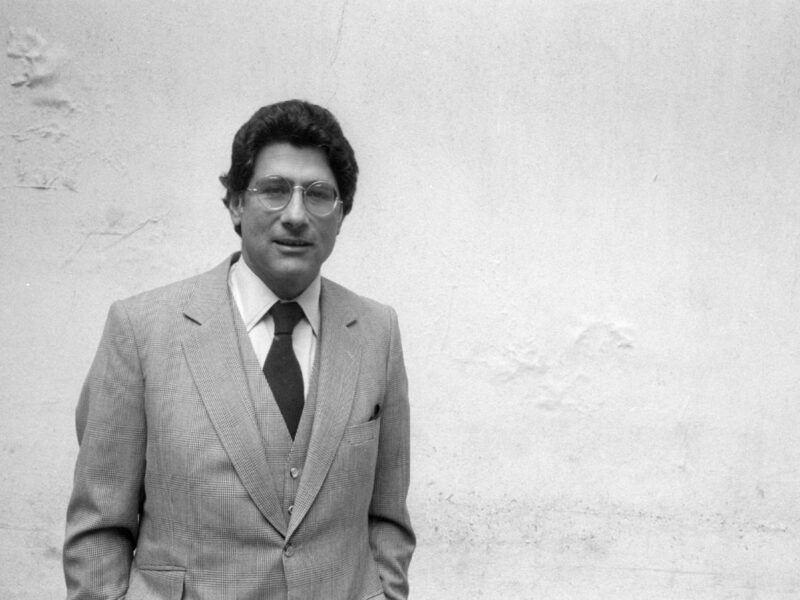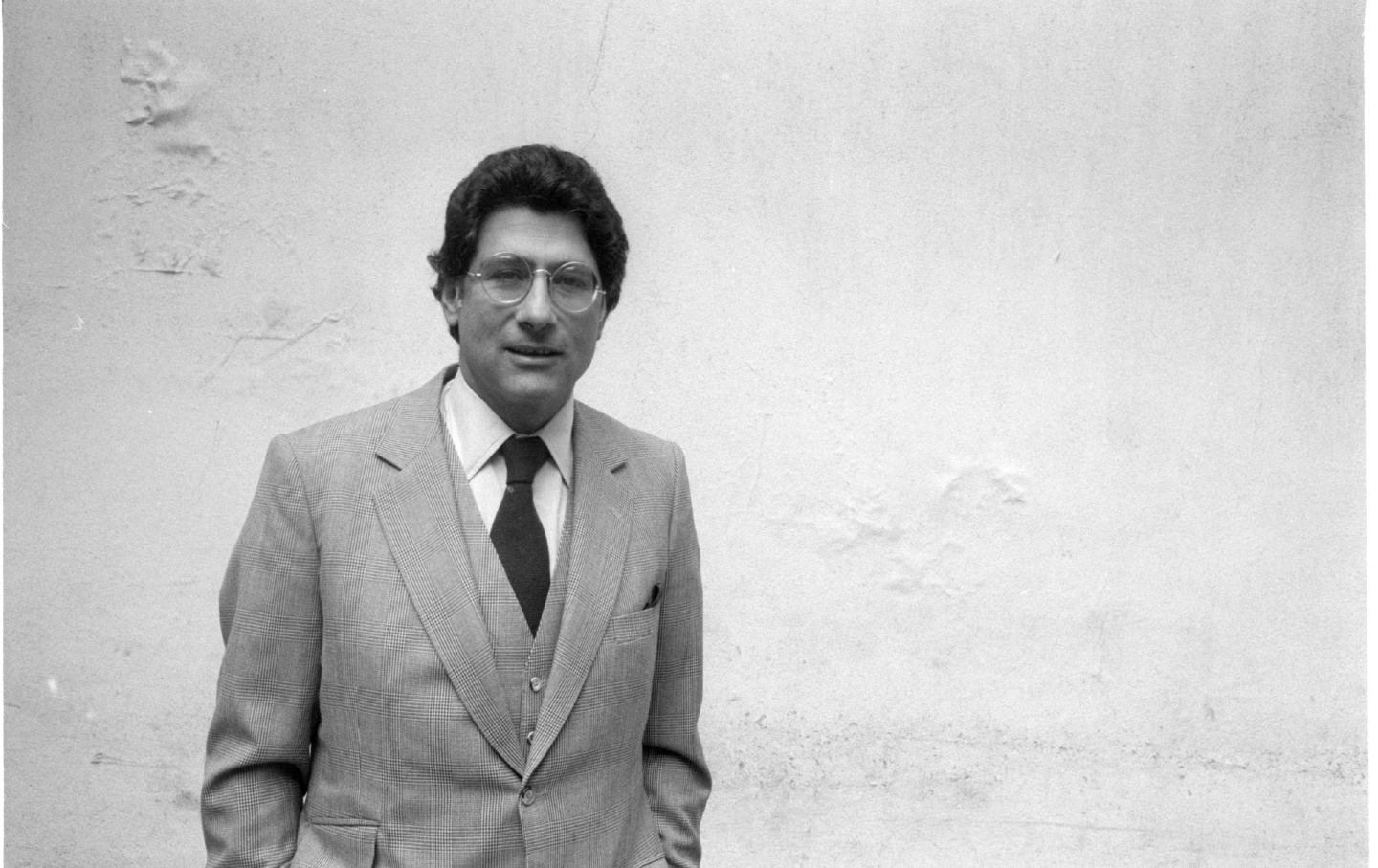
In the spring of 1991, Edward Said and his wife, Mariam, traveled from New York to South Africa, where the Columbia professor had been invited to deliver a lecture on academic freedom. Although Nelson Mandela had been released from Robben Island a few months earlier, apartheid was still in force—as was the academic and cultural boycott administered by the African National Congress, which had approved Said’s visit.
Read more Edward Said: Between Worlds
On arriving in Johannesburg, Said met briefly with Mandela, and was then taken for a much longer conversation with the ANC’s deputy president, Walter Sisulu, in what Said later described as “a deeply illuminating discussion” of the history of the South African struggle, with the ANC “now for the first time in its history in the ascendancy…with obvious points of difference and comparison with the Palestinian struggle, then, as now, very much not in the ascendancy.” The cordiality of the encounter, however, was marred for Said by the ostentatious display in the ANC leader’s office of a copy of Jerusalem: Sacred City of Mankind—a coffee-table book by Teddy Kollek, the city’s longtime mayor and international symbol of liberal Zionism.
Their conversation was not filmed, and is not featured in Edward Said: Between Worlds, the new documentary that serves both to introduce one of the 20th century’s most important writers and thinkers to a new audience two decades after his death in 2003 and as a deeply personal history of the Palestinian struggle in the 20th century. I mention it here not to fault the filmmakers, who have used their unprecedented access to the Said family archive (including a trove of 8mm home movies filmed by Edward’s father, Wadie Said, showing the writer’s childhood home in West Jerusalem) to assemble a deeply moving portrait, but to underline both what Said was up against—and how often even those who regarded themselves as sympathetic to his cause misunderstood him.
Both of these themes—opposition and misunderstanding—are of course central to Said’s 1999 memoir, Out of Place, which remains the essential text for anyone curious about the origins and evolution of this seminal figure, whose literary criticism, from Beginnings (1975) through Orientalism (1978) and Culture and Imperialism (1993), changed not only the way we read canonical texts from Dante to Conrad but also the way we view the interplay of politics, history, and culture. At the same time, beginning in the late 1970s, Said became (second only to his sometime ally, sometime enemy, Yasir Arafat, chairman of the Palestine Liberation Organization) the face of the Palestinian cause—certainly in the West.
Although much of this material has been covered before—in Out of Place, but also in the 1998 BBC documentary In Search of Palestine, and Edward Said: The Last Interview, a lengthy series of filmed conversations with the journalist Charles Glass that I produced and Mike Dibb directed, released shortly after Said’s death, not to mention Places of Mind, Tim Brennan’s 2021 authorized biography—Edward Said: Between Worlds offers a new, and more robust, narrative framework in which to situate a man who, as he says in the film (quoting Whitman), was never unaware of his own contradictions, or that he contained multitudes.
Edward Said was born in November 1935 in Talbiyya—at the time a prosperous, mostly Christian (Arabs and Armenians) neighborhood of imposing villas on large lots. His father, whose family belonged to the city’s tiny Anglican minority, ran a stationery and office supply business with outlets in Jerusalem, Cairo, and Alexandria. His mother, Hilda, was from Nazareth, where her father was a Baptist minister. That background, plus an American passport (acquired thanks to Wadie’s service in the US Army during World War I), nurtured a lifelong identity as an outsider—a sensation that secondary school in Cairo, where the family fled in 1947 as rising sectarian violence made Talbiyya unsafe, did nothing to assuage. But if Said felt out of place at Victoria College—sometimes described as “the Eton of the Middle East,” whose teachers were all British expats, and where his classmates included Omar Sharif and the future King Hussein of Jordan—he was even more isolated at Mount Hermon, a boys’ boarding school in Northfield, Massachusetts, founded by the Christian revivalist D.L. Moody.
As a discontented scion of the comprador class—his father’s firm, the Standard Stationery Company, prospered selling office supplies to the British military in Egypt—Said came somewhat belatedly to Palestinian nationalism, forging a conventional, if brilliant, academic career at Princeton, Harvard (where he wrote his PhD, later expanded into his first book, Joseph Conrad and the Fiction of Autobiography), and Columbia, where he became known as one of the few members of a deeply conservative English department to display any sympathy for the innovations in literary theory coming out of France. When I first went to his office in the winter of 1976, it was to ask if he might serve as adviser for an independent study of the work of the structuralist critic Roland Barthes. After a few fairly perfunctory questions, Said agreed readily.
Then, just as I thanked him and prepared to depart, he said, “I don’t know anything about your background. Tell me about your parents?”
I can’t recall what I said about my mother, but regarding my father I gave what by then had become my standard—and, I thought, terribly witty—response to such queries: “My father runs the Reading, Pennsylvania, branch of the International Zionist Conspiracy.” (He was then executive director of the town’s Jewish Welfare Federation.) Said’s only reaction was a blank look. I never forgot the exchange—or Said’s answer when, months later, I turned in my project and asked him why he’d only given me an A-. He replied that he felt I’d selected the evidence to fit my thesis—“and that, as an intellectual, you have a responsibility to the truth.”
Said didn’t join the Palestine National Council (as an independent, rather than a member of Arafat’s Fatah or any other faction) until 1977, the culmination of a process that began 10 years earlier, in the wake of the Six-Day War, when all of New York seemed to be celebrating Israel’s lightning victory. The complete absence of Arab voices or viewpoints struck Said as a scandal—one he was determined to expose and address, initially in “The Arab Portrayed” (1968), an essay first published by a friend from Princeton, the Palestinian political scientist Ibrahim Abu-Lughod, in a special issue of the Arab League’s monthly journal Arab World, and eventually in Orientalism, as well as in The Question of Palestine (1979) and Covering Islam (1981). By the 1980s, with Ronald Reagan in the White House and George Shultz (a fellow Princeton graduate who famously had a tattoo of a tiger on his rear end) as secretary of state, Said had become both the most prominent advocate for the Palestinian cause in the United States—a fixture on Nightline, Charlie Rose, and The Dick Cavett Show—and the leading interpreter of American politics to the Palestinian movement.
In retrospect, this might have been a good time for an Israeli government genuinely committed to the “two-state solution” to have finally specified that country’s borders and territorial claims, recognized a Palestinian government, and begun a period of peaceful, if uncomfortable, coexistence. Instead, under both Likud (Menachem Begin, Yitzhak Shamir, Benjamin Netanyahu) and Labour (Shimon Peres, Yitzhak Rabin) governments, Israel continued a program of land expropriation, settlement building, and systematic oppression that the 1993 Oslo Accord codified but did nothing to disrupt. For Said, who denounced Oslo as “an instrument of Palestinian surrender” and the celebrated handshake on the White House lawn as “a Palestinian Versailles,” the break with Arafat—whose 1974 address to the United Nations he had rendered into English—was now irreparable.
Said’s passage from Arafat loyalist and apologist to a critic so trenchant his books were banned by the Palestinian Authority will doubtless someday be the subject of scholarly elucidation. Likewise the evolution of his position on the question of one state/two states. Historians interested in either topic will find a wealth of material in this film—and even more in the source notes.
But for anyone interested in what shaped Said as a man, a critic, and an activist and intellectual, Edward Said: Between Worlds offers a superb introduction. Assembled from hundreds of hours of interviews and media appearances, and told entirely in Said’s own voice, the film depicts him in all his contradictory splendor: the elegantly coiffed and perfectly tailored tribune of an oppressed people, the man of the left who proclaimed, “I seem to be the father of identity politics, but it’s a thing I totally disbelieve in,” unfashionably tenacious in his defense of humanism and cultural autonomy, yet utterly intransigent when it comes to Palestinian rights.
That intransigence is crucial; the Palestinian cause would never have survived without it. But Said also argued that defiance alone, however essential, was not enough. His early complaint that “we have no narrative as a people,” the lack of academic attention to the Palestinian past, has been handsomely remedied by Nur Masalha, Rashid Khalidi (the Edward Said Professor Emeritus at Columbia), and other historians. However, the question of a Palestinian future has become even more fraught in the years since his death. And here the film offers two propositions, neither of them destined for universal assent.
The first is his dismissal of what might be called the Algerian example. There may have been no more fervent admirer than Said of Gillo Pontecorvo’s film The Battle of Algiers. Certainly there were few better informed about the film or the director, the subject of a short 1992 documentary, Pontecorvo: The Dictatorship of Truth, narrated by Said, who interviewed the Italian filmmaker and often spoke about the importance of the anti-colonial struggle of Algeria’s Front de Libération Nationale (FLN) in his own political awakening. And in recent years it has become increasingly common on the left to cite the Algerian revolution—in particular the FLN’s use of violence against civilian targets, as so unflinchingly depicted by Pontecorvo—as a model for the Palestinian struggle.
For Said, however, Algeria, though a successful example of a colonized people liberating themselves from a larger European power, also represented the perils and limits of nationalism. Perhaps influenced by his close friend Eqbal Ahmad’s critique of the “pathologies of power,” and certainly by his own distaste for what he saw as the constrictions and rigidities of identity politics, Said explicitly refused to advocate for the expulsion of Jews, or Israelis, as an appropriate goal for the liberation of Palestine.
“Any idea that the Israelis might have—or on the other hand, that the Palestinians might have—that the other will go away is madness,” he says in the film. “It just will not happen.”
In place of this nationalist fantasy—currently being perpetrated by the Israeli government, but still regarded as a consummation devoutly to be wished (so long as it is done by, rather than to, the Palestinians) by some of Israel’s critics—Said offers what he calls “the only sensible resolution: to think about a way in which [Israelis and Palestinians] can live together as equals.”
The possibility of such equality has come to seem even more remote now than it did when Said spoke those words in the summer of 2002. Yet, as he said at the time and as events since have repeatedly borne out, the only alternative is endless bloodshed. And here the film offers its second, equally subversive proposition: that in the playing of the West-Eastern Divan Orchestra—the ensemble, convened and supervised by Said and his friend Daniel Barenboim, incorporating young musicians from Israel, Palestine, and the Arab world alongside members from Turkey, Iran, and Spain—we might discern not just superb musicianship but the sound of equality and justice.
Toward the end of his life, Said became increasingly fascinated with what he called “late style”—the way in which old age seems to prompt some artists toward a greater acceptance, reconciliation, or striving for harmony, while others “tamper irrevocably with the possibility of closure, leav[ing] the audience more perplexed and unsettled than before.”
Troubling the waters of complacency was Said’s stock in trade. And here, too, the film’s director, Maiken Baird—a Danish American who first met Said as a teenager and was a student of his during the 1980s—has been faithful to her subject. Far from reducing Said to the two dimensions of iconography, she allows his characteristic asperity and astringency to emerge unfiltered.
At first glance, the film’s final focus on the Divan might seem like a soft landing—a fantasy happy ending for this most intransigent of public intellectuals. But like many aspects of Said’s story, that impression can be misleading. Because when we reflect on what the Divan presumes—not just genuine equality but also a shared culture that can transcend national boundaries—the radicalism of its founders’ ambition reveals itself. Far from lulling us to sleep, the music of the Divan, like Edward Said: Between Worlds, is a call to stop sleepwalking and awaken from the nightmare of our present.
Read more We Are Living Under Roy Cohnian Logic