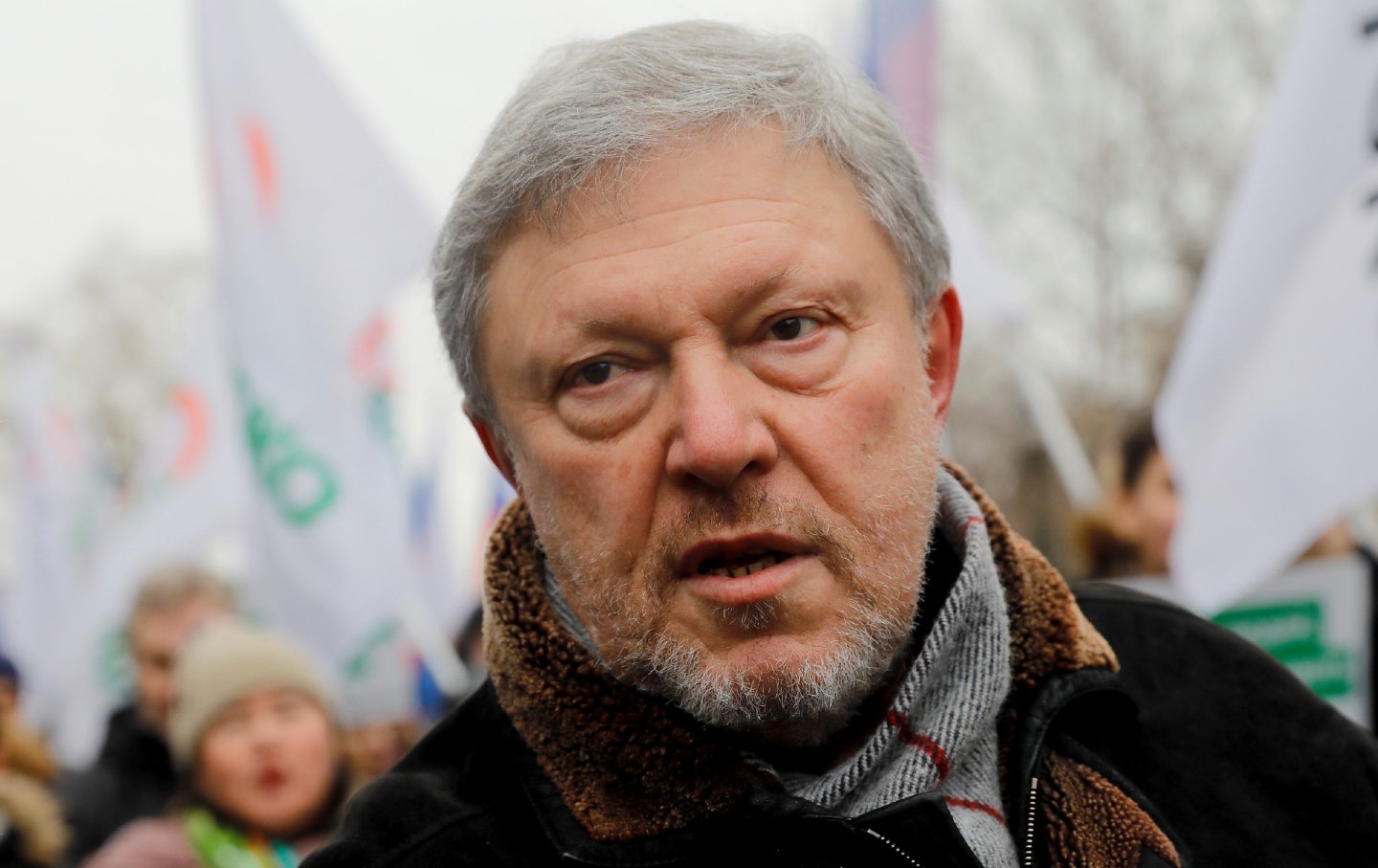
This interview with Grigory Yavlinsky, the founder of Russia’s Yabloko Party, comes in the run-up to national, regional, and local elections scheduled for September 20. The regime’s failure to achieve its goals in Ukraine and the increasing costs incurred by its retaliatory strikes across Russia, on cities and facilities that were not impacted even by World War II, is making the regime increasingly insecure, and its response to any critique is rapidly hardening. Since the start of the military operation, five members of Yabloko, including its vice chair and the recent head of its caucus in the Moscow City legislature, have been sentenced to terms in a penal colony, ranging from one to 10 years, and nine of its leading and most recognizable members other than Yavlinsky (who is not seeking office) have been banned from running in the elections.
Read more What Pope Leo Can Teach Liberals About Power
Whether the Kremlin will allow Yabloko to appear on the national party-list ballot will become known by August 5—the deadline for the Central Election Commission to finalize the registration of the parties. So far, the signals have largely been negative: Just in the past week, Yabloko’s slates were denied registration in two major cities of Russia’s northwest, St. Petersburg and Petrozavodsk, where it has been relatively more popular than in most of the country and was previously represented in city councils; meanwhile, in the only region where its slate has been registered to compete in regional elections (the Republic of Karelia, of which Petrozavodsk is the capital), a nationalist party sued to get that registration canceled. If Yabloko is kept off the ballot, the next question will be whether it is allowed to survive at all, in legal and financial terms, until the end of Putin’s rule.
—Katrina vanden Heuvel
Yabloko was founded in 1993. The Yabloko party’s electoral platform consists of the following 43 words:
For peace and freedom! For a life without fear!
For a cease-fire agreement, for diplomacy and for achieving peace!
Our goal is to avert a nuclear war!
For a Russia that is free of fear and of political reprisals!
For the preservation of human lives, respect, dignity and well-being!
Our goal is a prosperous, democratic Russia!
Yabloko is the only party that has steadfastly advocated for the cessation of military operations in Ukraine since 2022.
The Nation’s Nadezhda Azhgikhina spoke with Grigory Yavlinsky, Yabloko’s founder and the chair of its federal political committee.
Nadezhda Azhgikhina: Grigory Alexeyevich, what do you offer in these elections, and what do you expect?
Grigory Yavlinsky: Our message in these elections is the unconditional demand to put an end to the loss of lives, that is, to conclude a ceasefire agreement in the nearest future. This is the gist of our platform. It has merely 43 words in it. These elections are not about taxes, utility fees, salaries or pensions. They are about human lives, freedom, and Russia’s future.
In effect, this will be a referendum. Its plausible number of participants will be over 60 million. Unfortunately, Yabloko is the only party in Russia which stands for a ceasefire agreement with Ukraine, for freedom, and for a life without fear. All the other parties largely support the status quo.
These elections will essentially have two sets of results: the numbers that they will officially announce, and the real one. And the authorities will know how people voted in reality. That will be the main outcome—the top officials of the country seeing how many Russians actually support a ceasefire and that vision of Russia’s future that Yabloko offers, a vision that matches the future of the 21st century.
Elections are not the same as a sociological poll of some 1,500 people conducted by a government agency. Elections are the confidential vote by millions of people. It is possible that Yabloko has been allowed to run in these elections to gauge the actual sentiments of the people.
At this time for us, the seats in the parliament are not the main issue at play in these elections. The most important is to reveal what it is that a significant part of the people of Russia actually wants. Over the past four years, our position has remained the same: The loss of lives must be stopped; a ceasefire agreement must be concluded immediately; after that, diplomatic negotiations about the future must begin in earnest.
NA: What is the overall mood within the party? Recently, Yabloko has been under pressure as never before: Eight members have been arrested and are currently in jail, while many prominent party politicians have been barred from running…
GY: We got thousands of official party members and over a million of registered supporters; throughout this entire period, not one of them has filed a notice of leaving the party, in spite of the fact that, as you mentioned, eight of our colleagues have been imprisoned, that 12 of them have been under criminal charges, that dozens have been fined for stating our position about this military conflict in public, and that the party leader and all of its incumbent elected officials have been deprived of the right to run for office. And yet the number of young people joining the party has been on the rise. This is a sign that our party has a future despite all this pressure.
NA: Why did you not put yourself at the top of the slate?
GY: I did not do it because we ought to be paving the way for young people to enter politics. My generation lost its game by completely derailing the reforms of the 1990s. This brought our country to a catastrophic outcome. We had a historic chance, yet we failed to take advantage of it.
Now there is a new generation coming up, and our task is to support and help them in every way possible. Personally, I will stand with them in public and be helping them as long as needed, in terms of substance as well as funding. Right now, the image of the party whose slate of candidates is led by well-educated young people is very important. The future belongs to them.
NA: What is the geographic reach of the party?
GY: The entire country. We have enjoyed consistently high support in the northwest, in the Urals, in Siberia, and in the far east, as well as in major urban centers. There is a pattern in it; namely, our support is usually stronger in the old Russian cities, such as Tomsk, as compared to the large Soviet-era cities, such as Novosibirsk. Yet we are in a special moment: People’s mindsets have been changing in many ways, particularly over the past four years. For example, according to recent polls conducted on the Internet, our supporters made up 29 percent out of over 83,000 respondents. Our share of support in that poll was only exceeded by those who said that they were not planning to vote for anyone at all for the time being.
NA: The polls conducted by Zhivoi gvozd [A Living Nail], an anti-government YouTube channel, showed that 84 percent of its audience were prepared to vote for Yabloko. Does that mean that your message has finally been getting across?
Read more What Pope Leo Can Teach Liberals About Power
GY: Not only that. The point is that people are coming to the conclusion, on a substantive basis, that things just cannot be allowed to continue along the current track. First of all, it has been four years of casualties. And, of course, everyday challenges—inflation, gas prices, all kinds of restrictions, the threat of another mobilization—affect almost everyone, and they only keep growing.
It is unquestionable that we represent the political force that enables people to express their views of the current situation, by supporting us. Under present conditions, selling this to them is not the issue: People are facing serious problems, and they are starting to search for a solution.
NA: And what if at the last moment the authorities will rule out Yabloko’s participation in the elections?
GY: This can happen as well. If it does, the pressure on us will only become stronger. But we will not surrender our principles, our convictions, and our platform. And we do not plan our work based on conjectures. We do everything that is vitally needed in this time and place.
NA: In the West, you have been criticized at times for participating in the elections at all and for allegedly playing by the rules set by the authorities. What is your response?
GY: People who say these kinds of things either do not understand what this is about or are just making money there in this way. Let them come here and we shall discuss it.
Our position is simple: This is our country and our people. We will do everything that is needed so that people do not get killed and so that our country, as well as Ukraine and Europe have a normal future.
NA: Some people hold the view that reforms in Russia failed because of the “Russian destiny” and the “slavery gene,” and that democracy does not take hold on the Russian soil.
GY: The catastrophic failure of the reforms is the fault of specific individuals in Russia—and, by the way, of some Western officials too. By now, the contemporaneous records of, say, the US National Security Council have been declassified. They show that the US leadership refused to support our economic program for political reasons, despite the high marks given to it in professional terms. US Secretary of the Treasury Nicholas Brady said at the NSC meeting, speaking about the Soviet Union, that “turn them into a third-rate power…is what we want.”
Boris Yeltsin trusted the recommendations of his American advisers without questioning them. This was one of the main tragic errors.
That said, those inside Russia who were making decisions in 1991–99 still bear the primary responsibility for the outcome: the hyperinflation reaching above 2,600 percent, the criminality of the privatization procedure, and the formation of a corrupt oligarchic system that has no positive future.
NA: You talk and write a lot about the need to put human beings and their interests at the core of the new world politics. What should be done to achieve this?
GY: First of all, politicians in Russia and in the West ought to understand why reforms failed, why Europe has largely lost its diplomatic capabilities and is banking instead on weapons and escalation, and why the US is unable to secure a peace agreement.
In the absence of diplomacy, we have stayed on the present course for more than four years already. If this escalates toward a direct clash between Russia and NATO, nuclear weapons will be used in the very first days. There will be nothing else. I am gravely concerned about this and about the future.
Given the situation that we have, I believe that justice means first and foremost putting an end to the killing of people. Everything possible must be done to achieve this. All other issues can be discussed and resolved at the negotiating table for as long as it takes.
NA: What do you wish to Americans and to US politicians?
GY: To America, I wish the absolute best: that is, peace, prosperity, and success. I congratulate it on its 250th anniversary! I respect America and have very good feelings toward the American people. If you do well in every respect, this will be better for us too. Tackle your challenges, you got plenty of them. You cannot solve Russia’s problems. And do not hope that under the new conditions you can subjugate other countries. We need fundamentally novel, different, modern policies. And, by the way, do not think that money will always be on top of all other things. A lot will change in the middle of the 21st century.
NA: What gives you hope?
GY: I love my people. I love Russia, love Europe, and love America. I love people in general. My reason tells me that today’s policies can end up with very bad outcomes and catastrophic events. But my heart is not prepared to accept this, and I have hope.
Read more Zohran Mamdani and the Politics of Joy

