Pope Leo XIV was already in a tough spot when he acceded to the highest office of the Catholic Church just over a year ago. His predecessor and ally Pope Francis managed to move the needle on migrant and LGBTQ rights globally from within one of the world’s oldest institutions—which antagonized many of the church’s most revanchist elements. Observers the world over were eager to see whether the onetime bishop of Chiclayo, Peru, would pursue a similarly progressive pontificate, or attempt to conciliate the reactionaries. He answered decisively with a recent surprise move that political leaders contending with growing reactionary movements could stand to learn from.
Read more Zohran Mamdani and the Politics of Joy
As he ascended the steps of St. Peter’s Basilica for his public introduction, the Chicago-born pope was already caught between constituencies that wanted to build on Francis’s transformations and those intent on turning back the clock. Archconservative elements of the church eager to take back the reins after a decade-plus of Francis were initially mollified by Leo’s “traditional” presentation. Less of a public firebrand than his mentor, he cut a diplomatic figure that a friend memorably called “a dignified middle of the road.” But the most hard-line traditionalists proved impossible to satisfy. The fringe, ultraconservative Society of Saint Pius X (SSPX), long a thorn in the Vatican’s side, forced a showdown earlier this month. Dignified, middle-of-the-road Leo responded by unilaterally excommunicating not only the leaders but potentially adherents of the order.
SSPX was formed in 1970 by French prelate Marcel Lefebvre in direct opposition to the reforms of the Second Vatican Council, which among other things gave individual churches more leeway to run their own affairs, eased up on requiring traditional practices like the Latin mass, expanded dialogue with other religions and—somewhat ironically—diluted the pope’s own power by expanding the power of bishops. The order took its name from the early-20th-century Pope Pius X, whom it lionizes for his “unmasking of Modernism,” which it considers the ultimate heresy. (“Modernism,” in a Catholic context, is a term a bit like “woke”—it can mean drastically different things depending on who’s deploying it, but generally refers to attempts to reconcile the church with modern culture.)
While many of SSPX’s specific grievances would be arcane even to practicing Catholics, at its root is disgust with a (slightly) more open and democratic church that had understood that it needed to adapt to changing times, and a desire to strong-arm it back to insularity and intolerance. Its concerns map neatly onto the culture-war outrages that animate the contemporary far right, political and religious. The order, which counted under 1,500 members as of 2025, trains seminarians and holds liturgies around the word. The number of laypeople who attend their masses is contested, but The Guardian estimates between 150,000 and 200,000.
The institutional church never quite knew what to make of the Lefebvrists, as SSPX members are sometimes known, as they kept pushing the envelope. In 1988, after repeated warnings from church officials including Pope John Paul II, Lefebvre himself participated in the unauthorized consecration of four new bishops, after which he and all of those who participated were excommunicated. He died three years later, still at odds with the church, but in 2009, Pope Benedict XVI made the decision to reverse the excommunications of the four bishops, including Holocaust denier Richard Williamson, capping a series of efforts to bring the SSPX reactionaries back into the fold. Even Francis extended a hand, allowing SSPX priests to officiate marriages in 2017.
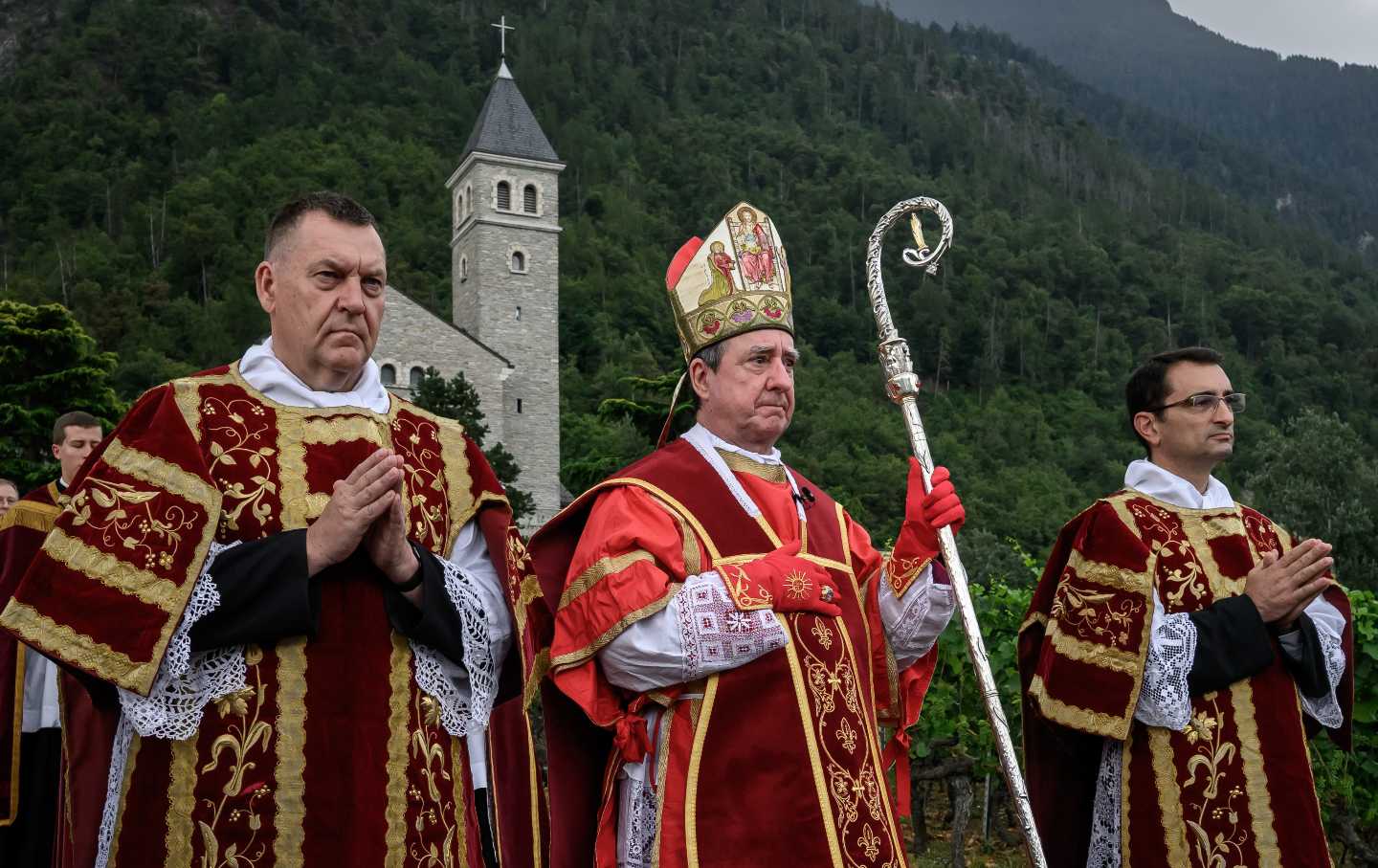
Fifteen years after Benedict’s reversal, SSPX did it again. Earlier this month, the society conducted the unsanctioned (and livestreamed) consecration of four new bishops at its seminary in Écône, Switzerland, before an audience of thousands, after repeated warnings from the Vatican. Leo shocked observers by declaring that the society had not just committed a schismatic act but was now itself fully schismatic from the church. He excommunicated its bishops (including two who had already been excommunicated in 1988 before the effective pardon), its priests, and certain laypeople who remained faithful to it. The Vatican set out a relatively onerous procedure for priests and adherents to return only after renouncing the order.
The severity of the sanction was surprising to many, given Leo’s known preoccupation with church unity and “synodality,” or a commitment to dialogue and openness. Yet what Leo and his advisers understand is that continued accommodation of SSPX would not help foment a pluralistic church but instead keep pulling it apart at the seams. Several consecutive pontiffs’ efforts to appease the splinter group out of a fear that it would otherwise tear the church apart were arguably what allowed it to build up the strength to once again act outside the Vatican. A complete removal of institutional backing and the threat of excommunication for its followers will most likely let the SSPX slowly die on the vine.
Pro-democracy leaders should take heed. Here in the United States, Democrats’ terror at alienating some imagined moderate base even in deep-blue areas have left us on the precipice of total reactionary triumph. After his 2020 victory, Joe Biden told the nation it was time to “turn the page as we’ve done throughout our history, to unite, to heal.” Just over two weeks later, Donald Trump incited an insurrection to violently prevent the transfer of power, in tandem with a battery of procedural efforts to overturn the election.
Read more Andy Burnham Is Not to Be Trusted
Some four years after that, Trump entered the presidency again, having faced practically no meaningful repercussions for these or any other actions. In France, far-right National Rally leader and convicted embezzler Marine Le Pen has announced that she will run for president after an appeals court shortened her ban on running for public office. Ten years ago, UK Prime Minister David Cameron called the Brexit vote, thinking he was throwing a bone to the rabid right-wingers that would put the matter to bed. Instead, he lost, to disastrous consequences for his country and for Europe.
The Vatican, of course, is not a democratic country but an essentially monarchical institution in which the pope is vested with the authority to make these sorts of sweeping decisions more or less unilaterally. There is no Congress to negotiate with and a far less complex system of checks and restrictive case law and so on, and this is by design in both directions. We should certainly not jettison democratic constraints to combat the encroaching far right, which is ultimately the same thing they want to weaponize anyway.
Nevertheless, there’s a useful underlying lesson here for both liberal and progressive constituencies: Our institutional systems cannot actually accommodate everyone. This is a tough pill to swallow for any political vision that has an “all are welcome” bent. But we can’t welcome the people and groups who’ve made it their mission to set fire to our governments and institutions—whatever their inadequacies, these are the most consequential tools in trying to build just societies. These elements must be isolated, starved of resources, held accountable where possible, and eventually ignored. There is no moral law that requires us to listen to and work with the opponents of human dignity or civil liberties.
There’s also something to be said here about the virtue of just ripping the Band-Aid off. I’m sure there were alternative and more conciliatory plans for dealing with SSPX, in keeping with the Vatican’s decades of gentler admonitions. But what would that have achieved, exactly? It’s not like the sect hadn’t been warned that it was inching toward this outcome. Leo had specifically implored the group not to proceed with its unsanctioned consecrations, begging SSPX Superior General Fr. Davide Pagliarani to “please turn back” in a letter just days before they went ahead anyway. Pagliarani and his followers knew that this was a direct and public challenge to Vatican authority and went defiantly forward.
After his excommunication, Pagliarani wrote a letter to Pope Leo that defended the order as answer to the Catholic Church’s “moral confusion” and called the schismatic adherents victims of “unjust and invalid” sanctions, but simultaneously implored the church to allow SSPX back into the fold “for the good of the universal church and of Your Holiness.” You could replace a few words here and imagine identical statements made by revanchist political groups around the world, from the MAGA contingent to Le Pen to Hungary’s Viktor Orbán. They are perennially both a steadfast voice of reason doing what must be done, and put-upon victims of injustice by a decadent power structure, and they must always, always be accommodated for the good of the whole.
Moves like the illicit consecration aren’t just petulant for their own sake; they’re tire-kicking. Each time that an institution draws a line in the sand and then allows reactionaries to step over it, the latter walk faster. Leo’s following through with real consequences doesn’t necessarily mean that SSPX collapses—its diehard faithful have believed they’re in conflict with the church for decades, and some will stick it out—but it will make it less relevant, take away its institutional power, and deprive it of legitimacy and followers. The reactionaries can preach to half-empty rooms.
