In the wee hours of September 7, 2025, his 95th birthday, Sonny Rollins received news that felt like a dream: The secretary of the Navy had ordered his father’s wrongful 1946 court-martial conviction to be overturned. The jazz legend, who died on May 25, had been waiting eight decades for justice to be served. A draft of this article is one of the last things he read—a final coda to a life spent fighting injustice.
Read more America Is Due for a Deep Clean
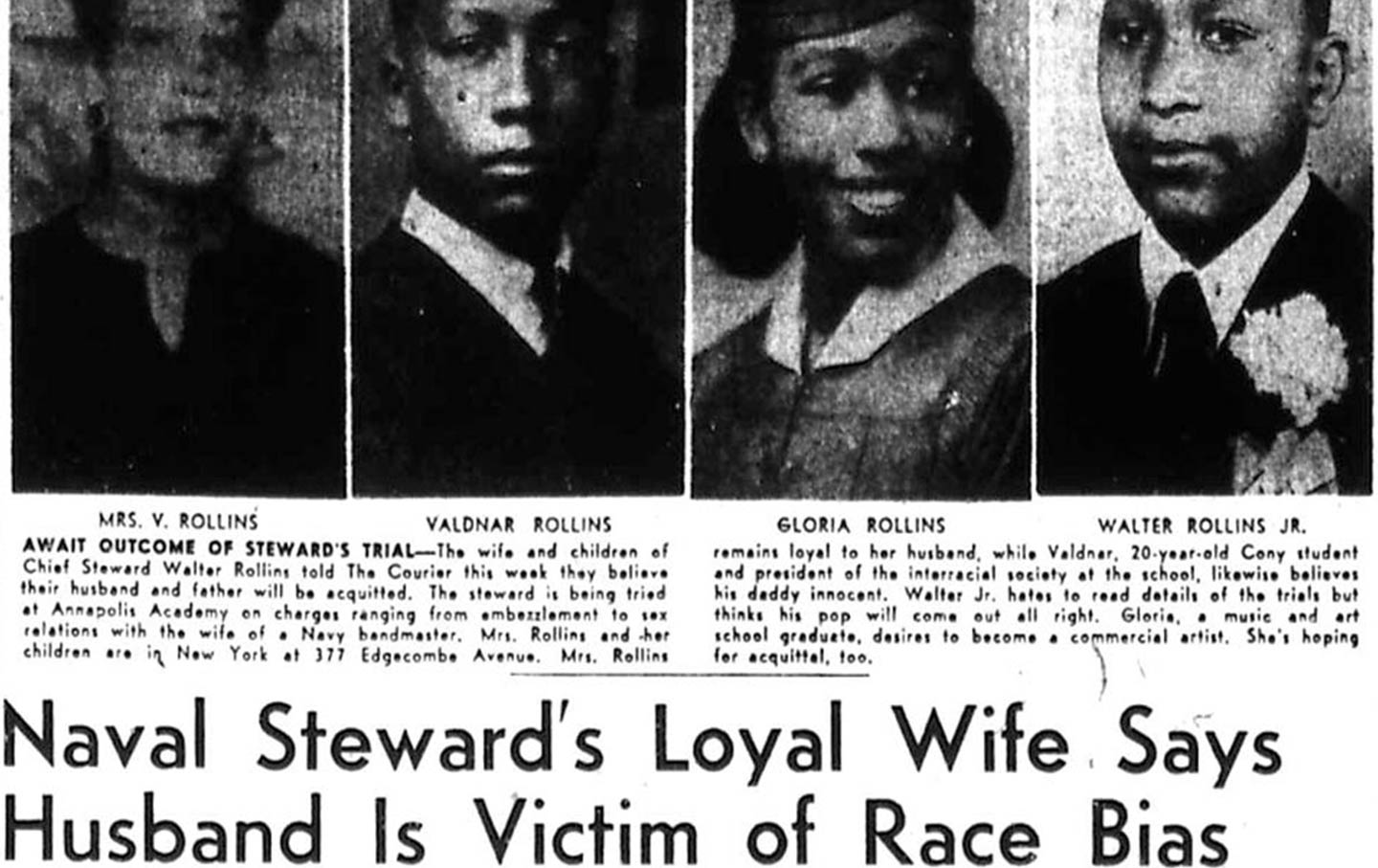
Walter William Rollins was a decorated naval steward who had served generals, presidents, and members of Congress. He was arrested 80 years ago this past February on charges of committing adultery, violating a taboo of interracial romance with a white woman. For this and other unproven charges, ranging from “scandalous conduct” to embezzlement, he faced up to 180 years in a naval prison.
In his 26 years of service to the Navy, Walter Rollins had maintained a spotless record. He had risen to the rank of chief steward at the US Naval Academy in Annapolis, the highest a Black service member could attain at the time. The armed services remained segregated until 1948. There was no material evidence of any wrongdoing, and both the woman in question and her husband vehemently denied the allegations. Adm. Arthur W. Radford, a close friend of Walter Rollins who would soon become the second chairman of the Joint Chiefs of Staff, served as a character witness. However, congressional pressure and an all-white court-martial in Jim Crow Maryland meant that injustice prevailed.
Sonny celebrated his 16th birthday by going with his family to say goodbye to his father before the start of his two-year prison sentence.
“It was like being lynched,” Rollins recalled recently, speaking of his father’s ordeal. The posthumous exoneration marked a stunning reversal. “You don’t hear stories like this, because they don’t happen,” he said. “This happened.”
And yet, for decades, Rollins pretended that this legal lynching never happened. “I had sort of eliminated what happened to him from my mind,” he said. “It was a terrible thing to go through, and so I had to get away from having to think about that the rest of my life.”
I discovered this buried family secret while doing research for Saxophone Colossus: The Life and Music of Sonny Rollins, the biography I published in 2022. There was no mention of this traumatic chapter in Rollins’s life in his voluminous archive at the New York Public Library’s Schomburg Center for Research in Black Culture, nor in the thousands of interviews with Rollins. Terri Hinte, his publicist of 50 years, had never heard about it.
After the story of Walter Rollins’s arrest broke, though, it was anything but a secret. The scandal was reported in The Washington Post, the Chicago Tribune, the New York Daily News, and hundreds of other publications in the US, and as far away as Sydney, Australia, in exhaustive detail, displaying a rush to judgment in the court of public opinion. Some articles referred to Walter as “Othello.” Sonny’s first mention in print was not about his music, but in connection to the case.
Following the revelation of this ordeal in the book, Rollins was reluctant to reopen that door and risk crushing disappointment. “He was already living with this, he was resigned to it, there was nothing that could be done,” Hinte told me. And yet, “it was so clearly a gross miscarriage of justice. How can you just be resigned to that?”
Read more Special Issue: America at 250
So as my press tour unfolded, I began quietly working with Hinte to see if this wrong could be righted.
I found Tamara L. Miller, a veteran civil-rights attorney and retired Air Force Judge Advocate General (JAG) Corps officer, who immediately agreed to take on the case despite the overwhelming odds. “I knew that Sonny’s father was wrongfully charged and prosecuted, wrongfully convicted, wrongfully incarcerated, wrongfully punished—and certainly wrongfully denied justice, despite the former chairman of the Joint Chiefs of Staff always being in his corner,” Miller said. “It just doesn’t get more compelling for a civil-rights lawyer to find such a righteous case. So it didn’t matter to me that it was highly unlikely that we could overturn a World War II–era criminal court-martial conviction. What mattered to me was that the story be told.” Through indefatigable research and advocacy, and following a protracted legal battle with the Board for Correction of Naval Records for more than three years, Miller ultimately won the case.
Soon after Rollins’s high-school graduation in 1947, his father was released from prison on a reduced sentence. Back in civilian life for the first time in decades, he worked a series of low-level jobs, mainly as a line cook in New York restaurants, “all jobs that were below his stature,” Rollins recalled. “He continued his life, without remorse, and this is another way that I respect my father so much, having to endure what he had to endure.”
As for Sonny, he took the fight to the bandstand. In the arc of his seven-decade career in music, every bent note bent toward justice. In his 1958 liner notes to Freedom Suite, the first civil-rights-themed album of the hard-bop era, Rollins wrote that Black people “exemplified the humanities in our very existence,” yet are “rewarded with inhumanity.” It was a lesson he first learned at home.
In 1959, the year that Rollins began his legendary sabbatical, vanishing from the jazz scene to practice up to 16 hours a day on the Williamsburg Bridge in New York, his father made an unexpected return to military life. He secured a pardon from President Dwight Eisenhower, which allowed him to reenlist at the lowest rank so he could work until he was eligible for his long-overdue retirement. But even a presidential pardon could not undo the public shaming, reverse his bad-conduct discharge, or entitle him to compensation for the years of lost pay.
“Even after his career and reputation were destroyed by unfair and racially motivated court-martial proceedings, the Subject maintained his dignity and remained loyal to the Navy,” read the Navy’s decision. “The Board found the Subject to be a truly extraordinary man who deserved much better than he got for his service to the Navy, and that it is long past time to right this wrong.” At long last, the Navy has restored Chief Rollins’s record, with back pay and interest. “I think it’s sort of like a candle in the dark for the country, for people to see that this has happened,” Hinte said.
For Rollins, this was the realization of a dream deferred, a triumph against injustice he had previously achieved only onstage. “I loved my father. He was the highest type of human being,” Rollins said. “Whatever they did to him, they didn’t turn me against America. There was still Coleman Hawkins and Charlie Parker. And nobody could top that.”