When Brendan Salisbury’s phone lit up with a notification from Grindr in February 2022, he saw a message from a stranger. It had four words and a photo of his front door.
Read more Justice for Macklemore
“Found you, commie faggot,” the message read.
For Salisbury—who had been receiving hate messages on social media for weeks after being quoted in a Vice article as a counterprotester at a Boston “Straight Pride” Parade—the anonymous threat was the last straw. He didn’t feel safe in his own home.
He was going to buy a gun.
“I mean, what was I going to do?” Salisbury said. “Call the police and say, ‘Hey, I got a message on Grindr, and it disappeared, and I can’t show it to you, but I promise it was a death threat?’”
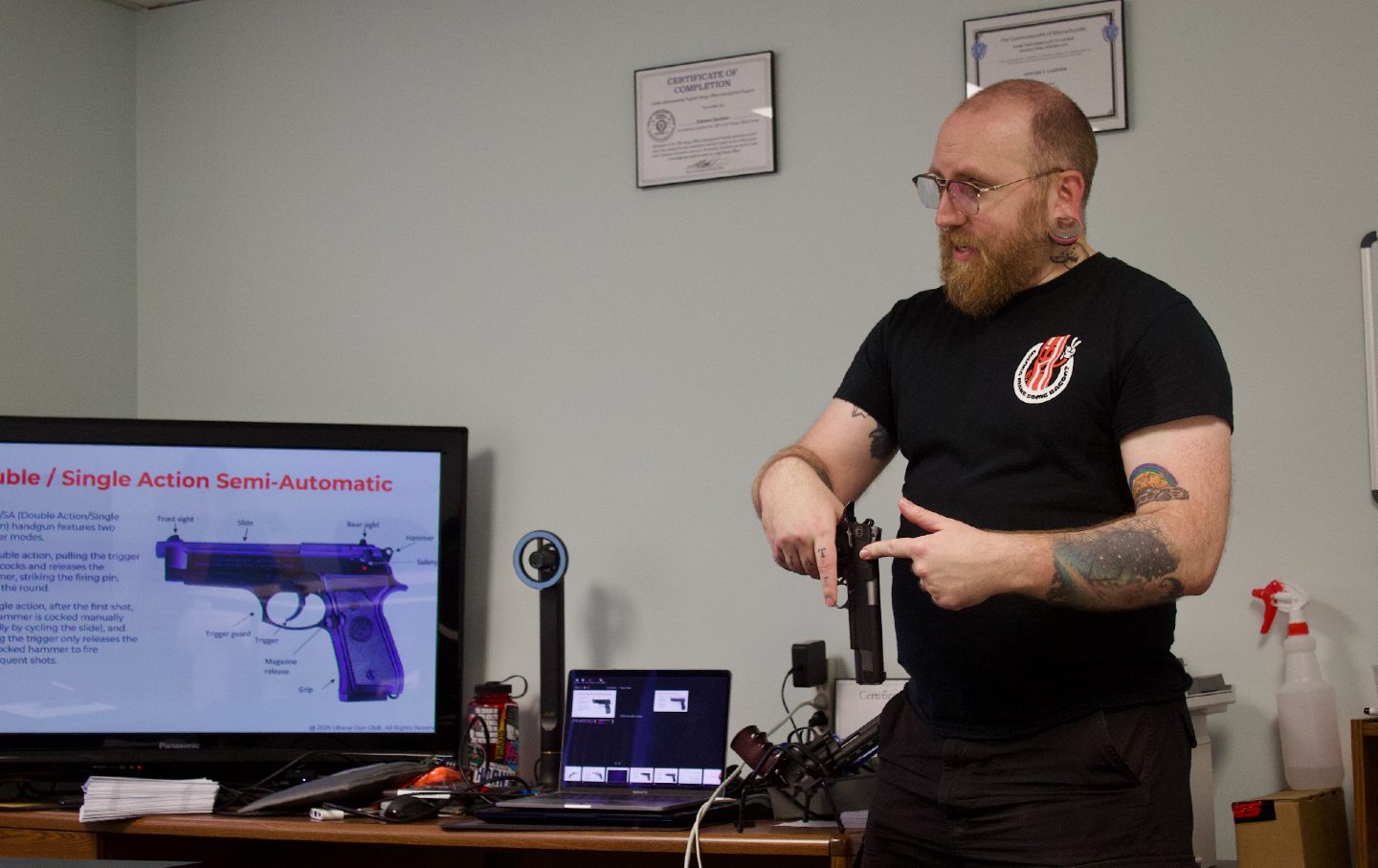
Salisbury spent the next few months getting his license, then bought himself a pistol on Christmas Eve in 2022. Today, he’s an instructor with the Liberal Gun Club, a national nonprofit headquartered in Massachusetts. He’s one of many left-leaning gun owners in the state for whom political tensions are prompting them to arm themselves. Many are seeking to repeal a state ban on assault weapons through an initiative this November.
The Liberal Gun Club, which has chapters in more than 30 states, reported a spike in interest as ICE raids ratcheted up early this year, resulting in the shootings of Renée Good and Alex Pretti in Minneapolis.
In the first two months of 2026, the group received 2,000 new training inquiries, according to Ed Gardner, the club’s executive director. That’s as many as they got throughout all of 2025.
Gardner describes an “if you’re not with us, you’re against us” mentality that he believes is fueling interest in his organization.
“[Leftists are] afraid, frankly, of their fellow citizens,” Gardner said. “It’s not just the government that you have to be sort of wary of. It’s the people who espouse and champion what the current government is doing.”
Zachary Hobbs—galvanized by the chaos of Trump’s second term—was among those who decided to arm themselves in the past year. He took safety training with the Liberal Gun Club in April.
“I have so much hurt and anger and sadness in what this country has become, and I don’t know what to do with that now,” said Hobbs, a Rhode Island resident.
His partner is transgender, and he’s worried that they might one day become a target of violence. Seeing anti-trans rhetoric swirl in political discourse led him to believe that being physically armed will keep his loved ones safe—or at least help them feel that way.
“I don’t think violence is the way to solve it, but I will admit I’ve been curious about violence as a mechanism to keep my partner safe,” Hobbs said.
For Dana Phillips, a trainer with the Liberal Gun club who is trans, that same worry about targeted violence motivated them to explore guns.
“I used to be deeply, deeply worried about where we were heading as a country, and how we were treating minorities, and how, as a trans person, my safety was going to be directly impacted,” Phillips said.
For years, they had been training in emergency medicine and had become certified as an EMT. That skill felt like enough to protect themself, until the January 6 Capitol insurrection—after which point Phillips began to see guns as a means to safety.
“After J6, I was just like, ‘Crap, the power structures are either actively colluding with this activity or are powerless to stop it when it happens. I feel like I am obligated to start learning this skill,’” Phillips said.
Spikes in membership in the Liberal Gun Club have historically corresponded with significant political events, according to Gardner, including Trump’s election in 2016, protests after the George Floyd killing in 2020, and Trump’s reelection in 2024. But Gardner said he hasn’t seen anything like this winter’s 100 percent membership spike in his 12 years leading the organization.
“[This era has been] a bit of a wake-up call for what I might call white middle-aged people who suddenly saw themselves in the news and they didn’t like what they saw,” Gardner said.
Timothy Gagnon got his license in Massachusetts in 2022, hoping to start a new hobby. But in recent years, he said he thinks about his guns in a more political way.
“I do think that leftist gun ownership can kind of help prevent a power imbalance between political opponents that are bitterly divided right now,” Gagnon said. “It’s a lot harder to shoot at your neighbor if they are also armed and trained and willing to shoot back at you, right?”
Massachusetts bans assault weapons via HB4885, an omnibus law that also developed an electronic tracking system for firearm ownership in the state, created a system to serialize homemade firearms, and widened the state’s “red flag” system, allowing school administrators and healthcare professionals to request that someone who poses an immediate danger to themselves and/or others surrender their guns.
An initiative to repeal HB4885 will go before voters in November, but polling shows that the law will likely remain intact. According to an August poll from the University of Massachusetts and Springfield TV station WWLP, 70 percent of respondents were in favor of retaining the restrictions.
Part of the reason some gun owners oppose the law is because they say it’s hard to interpret. The ban on assault weapons defines them by exact make and model, and bans guns and gun parts that are determined to be sufficiently similar to banned firearms.
Gun owners say the rules get confusing because guns have to be assembled and disassembled, and parts can be legal on their own but illegal when attached in certain configurations.
“It’s really difficult to know whether or not you’re accidentally becoming a felon if you do something in the wrong order or with the wrong piece of metal,” Gardner said. “Our definitions of assault weapons are spurious.”
Gun control advocates are urging voters to uphold the law, arguing that tighter restrictions on assault weapons and licensing will keep people safe from violence.
Read more Edward Said: Between Worlds
“It would be disastrous if this law were to be repealed,” said Elisabeth Ryan, policy council at the pro–gun control nonprofit Everytown for Gun Safety. “It not only brought new, very necessary gun violence prevention measures to Massachusetts to keep up with the emerging threats, things such as ghost guns, but it also, in lesser-known ways, overhauled a very piecemeal, very convoluted, very complex licensing system.”
Everytown ranks Massachusetts third on its list of states with the best gun legislation.
But for gun owners like Alex Schwartz, a Massachusetts trainer with the Liberal Gun Club, the laws just make things harder for people who are already following the rules, rather than stopping bad actors.
“It doesn’t get at any of the issues that create unsafe [situations] around firearms,” Schwartz said. “It was only focused on what lawful gun owners—people with licenses to carry who aren’t committing any crimes—what they can and can’t own, and what the firearms they own can and can’t look like.”
Gagnon, a current New Hampshire resident who lived in Massachusetts for most of his life, said he’d be in favor of other ways to tighten gun access, just not an assault weapons ban.
“I think an appropriate measure is to put more requirements in for training and background checking people, but then don’t tell them they can’t have a black gun with an adjustable stock on it because it’s an assault weapon,” Gagnon said. “I think that’s silly.”
Regardless of the outcome of the question in Massachusetts, left-leaning gun owners want to dispel stereotypes around gun ownership.
“I think that there is a truly massive community of people who are curious about guns and have been driven away because they believe that there is no space for them, and that’s simply not true,” Salisbury said.
And public opinion might be softening. Schwartz tabled for the Liberal Gun Club at Boston Pride this summer and found their reception to be widely positive.
“I’d say the overwhelming response was, ‘We’re happy to see folks like you here. We’re happy to know you exist. How do I get more information?’”
Tom Vosganian, a 20-year-old student at Boston College, has also noticed the same softening trend among his peers in College Dems clubs and campaigns he’s volunteered for. He worked on Ed Markey’s reelection campaign as well as for Daniel Lander, a progressive who lost narrowly in a challenger bid for Massachusetts state Senate.
But for him, that’s more of a byproduct of attention shifting elsewhere than a positive momentum of support for guns.
“It’s never really an issue that comes up,” Vosganian said. “The cost of living is very important, as are the myriad abuses of power coming from the federal government. It seems as though gun control and guns in general were just a much more hot-button issue during the Obama era.”
If it’s true that active opposition to guns is slipping relatively lower on Democrats’ agendas, that can also open the possibility that guns may act as common ground between some on the left and many on the right.
And for Phillips, guns might be a means to easing polarization between the left and the right.
“If they knew more people on the left that had guns, maybe they’d be more receptive to sort of our ideas about what it means to be a responsible citizen and take care of each other,” Phillips said. “Firearms can definitely be a space to cross those political blocks.”
I was born and raised in Massachusetts by mainline Democratic parents who shrunk from guns. I had never held one before. When Phillips offered to take me to the gun range during my interview with them, I took them up on it.
It was already hot when I arrived at Mansfield Fish & Game at 9 am. There were about a hundred yards of dusty ground, then a berm. After about 20 minutes of prep with toy guns and ammo, I donned clunky headphones and protective eyewear. I picked the small handgun, a Glock.
My hands shook on the pistol, like they did the first time I drove on the highway. Maybe I had too much coffee. Or maybe my hands always have a slight tremor. Or maybe I was scared.
A faceless paper torso stood in front of me, a circle over its imaginary heart. I pulled the trigger, then again, and again, each time bringing about shockingly loud pops and the strong urge to close my eyes and drop the killing thing in my hand. I suddenly understood what’s empowering, about shooting things that can’t shoot back, in the event that the target isn’t paper but flesh, hands outstretched, gripping a gun of their own.
But it made me want to run away from the world where these things exist, not spend my weekends practicing for the day I might violently die.
I wasn’t alone in this feeling. Hobbs, too, said his interest in guns cooled after actually handling one. Since his training with Phillips and the Liberal Gun Club in April, he hasn’t bought a gun or finished the licensing process.
“If anything, the training made me more fearful of handguns,” Hobbs said. I thought it could kick off a deepening interest in gun culture…. I didn’t actually expect that it would make me take a step back.”
Phillips said that fear is normal, but for them, it doesn’t make guns any less necessary.
“An armed society is more likely to have randomized violence,” Phillips said. “It’s mutually armed destruction—I guess, a terrible way to live, but it beats dying.”
Read more Edward Said: Between Worlds

